

The way software gets built is changing faster than most delivery leaders realise. For over a decade, the industry ran on a single operating model: cross-functional teams of 8-10 people, two-week sprints, predictable velocity, a linear relationship between headcount and output. Every staffing model, every margin calculation, every proposal template was built on that assumption.
That assumption no longer holds. In our experience, engagement after engagement, we keep seeing the same thing: AI does not accelerate large teams, it makes small ones sufficient. We believe the teams that win now are small, senior, and augmented by AI tools, with a human firmly in the decision loop. Organisations that understand this shift and act on it will gain a structural advantage. Those that wait will keep running an operating model designed for a world that no longer exists.
This article unpacks what that shift looks like in practice, what it demands of your operating model, and how to get that capability into your delivery without rebuilding your whole organisation.
Our answer: small, senior teams with a human in the loop
We did not arrive at this model through theory. We built it in practice, running engagements across technology, banking, and e-commerce, and watching the old delivery assumptions break down in real time.
What emerged is a small, senior-heavy team working alongside a dedicated layer of AI agents. Humans set direction, evaluate outputs, and make the calls; agents do the heavy lifting. Three roles. Disciplined orchestration. Output that scales with compute, not headcount. It is a human-in-the-loop delivery model, not an autopilot: the people are the reason it works.
Three stages of AI adoption in software delivery
Organisations are moving through three distinct stages, and the gap between early movers and everyone else is widening fast. The right response looks very different depending on where you sit.
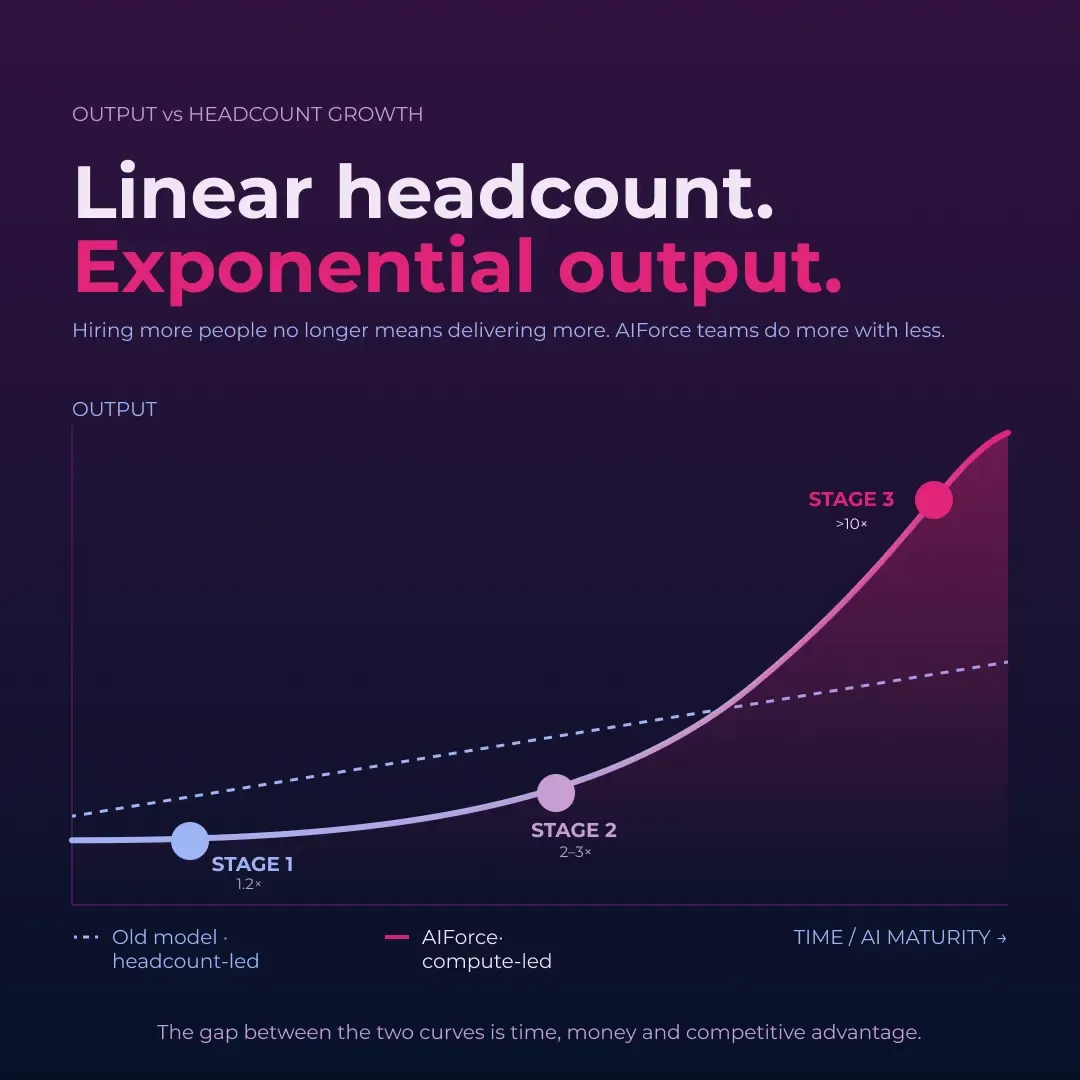
Stage 1: AI-assisted development. Individual developers use AI tools to speed up discrete tasks. Team structure and process stay the same. The productivity gain is real but modest, in the range of 20-30%. No fundamental change to the delivery model is required.
Stage 2: Agentic delivery. AI agents handle complete tasks end to end: feature implementation, test generation, code review, documentation. Sprint cadences compress, specialised roles begin to consolidate, productivity jumps to 2-3x the previous baseline. The delivery model needs adjustment.
Stage 3: Agentic operations. Engineers shift from writing code to designing systems that write code. The core team drops to two or three people. A human “day shift” sets direction and reviews outputs; an agentic “night shift” executes. Output scales with compute, not headcount, and the productivity potential exceeds 10x. The delivery model has to be rebuilt from scratch.
In our view, most established organisations sit between Stage 1 and early Stage 2, while AI-native competitors already operate at Stage 3. This is the way our teams work today, and the capability our clients bring in when they work with us.
What does an AI-augmented team look like in practice?
The pattern that consistently works is a small, senior-heavy team built around three functions, not job titles. Most of the implementation sits on the AI side. Humans define, evaluate and decide. Concentrating decision-making into three senior roles is what makes the model work.
- Product Definer owns the business outcome, sets the quality bar for the agentic workflows, and validates that AI-generated output matches user and stakeholder intent. This needs stronger technical literacy than a traditional product manager, because the job is evaluating outputs, not writing acceptance criteria for humans.
- Tech Lead holds the full architectural picture, makes the design decisions, and orchestrates the AI models and agents: choosing the right model for each task, designing the workflow, and keeping the system coherent.
- Builder drives the day-to-day delivery cycle, validates and reviews AI-generated artefacts, and continuously improves the agentic setup itself: refining prompts, building custom agents, optimising handoffs.
Each role is supported by a dedicated agent layer. An implementation agent generates code, tests and documentation. A verification agent assesses output quality and flags architectural deviations. An orchestration agent manages workflow across models and tools. Humans decide, agents execute.
On a recent engagement of ours, this structure let us ship a production-ready solution in two-thirds of the originally estimated time, with a team roughly half the size a traditional approach would have needed. We did not trade away quality, and the architecture stayed clean. That was not luck. It was seniority, clear role definition, and disciplined AI orchestration.
What changes in your operating model?
Whether you build this in-house or bring in a team that already works this way, the same things shift. It is a structural change that touches team composition, planning, metrics, and the commercial model.
Team structure. Dedicated QA, separate frontend and backend tracks, a standalone junior tier: these do not disappear, they consolidate into fewer, broader, more senior positions. Competency frameworks and career ladders have to reflect that.
Capacity planning. People x hours x utilisation no longer produces a reliable forecast. A three-person AI-augmented team with strong orchestration can outproduce a ten-person one. Your planning has to account for AI token costs, decision-making bandwidth, and the higher per-person cost of a senior-heavy team.
Metrics. Velocity, burn-down and story points measure effort, not outcomes. What matters here is time from idea to working software, decision throughput (how many review-accept-reject cycles a day the team can handle), AI output acceptance rate as a leading indicator of workflow quality, and outcome metrics tied directly to business results.
Pricing and engagement structure. When the cost of delivery drops sharply while the value to the client holds, time-based pricing becomes hard to defend. The engagement shifts from a staffing plan to a scope-and-outcome commitment.
Regulatory obligations. None of this exempts anyone from compliance. AI Act, DORA, GDPR, audit trails, high-risk system classification: for clients in banking, insurance and manufacturing these are entry conditions, not optional extras. A shorter decision chain does not mean less process, it means a more disciplined process with fewer layers between a requirement and its verification.
Five decisions that cannot wait
The window for building a structural advantage is open, but not unlimited. In our view, these are the calls delivery leaders need to make in the next twelve months.
- Define your team archetype. What does the minimum viable AI-augmented team look like for your most common engagement? Which roles, seniority levels and AI tools does it need? Build a repeatable template, not a one-off experiment.
- Redesign your competency framework. AI orchestration, cross-functional versatility, and high-quality decisions under ambiguity have to become first-class evaluation criteria. A senior developer who cannot work effectively with AI agents is not senior by 2026 standards.
- Run one outcome-based engagement. You do not need to change your whole commercial model overnight, but you do need to learn what outcome-based delivery feels like to scope, track, and price. Pick a contained project and start.
- Rebuild your capacity model. If planning still assumes a linear headcount-to-output correlation, it is producing wrong numbers. Include token costs, decision bandwidth, and the compounding effect of AI on senior engineers’ output.
- Protect and grow your senior talent. This model is only as good as the people orchestrating it. Architectural judgment, pattern recognition, and fast, high-quality decisions are not what AI replaces, they are what makes AI effective. The competition for these people is intensifying.
The shift is already happening
We deliver in this model every day: e-commerce CDP work, legacy modernisation in financial services, internal tooling for industrial clients. Humans in the loop, AI handling the volume, senior engineers making the decisions that matter.
If you need this capability now, the fastest path is not rebuilding your organisation, it is bringing in a team that already works this way. That is what we provide: small, senior, AI-augmented delivery teams you can plug straight into your roadmap.
Talk to us about a team of experts, augmented by AI → Team augmentation