

IT outsourcing is one of the most strategic calls a technology organisation makes. Companies use it to control cost, scale engineering capacity on demand, and reach specialised expertise that is hard to hire internally. In our experience, none of that is where outsourcing goes wrong. It goes wrong when the conversation stops at day rates and headcount, and never gets to the question that actually decides ROI: are the people on the team senior enough, engaged enough, and well-run enough to turn paid hours into delivered value?
Industry benchmarks put the leak at 20 to 30 percent of external IT budgets spent on work that never becomes productive, client-facing output (source - Software Development Outsourcing Statistics 2026 - SQ Magazine). That waste rarely comes from fraud. It comes from thin seniority, context switching, idle time, and vendors managed by timesheet rather than by outcome. This guide walks through the cooperation models we run at RITS, what each one costs and controls, and how we build teams that close that gap instead of hiding inside it.
What is IT outsourcing, actually?
Outsourcing means contracting technology work, roles or whole functions to an external provider instead of relying solely on permanent in-house staff. It ranges from placing a single specialist inside your team to running an entire delivery unit as a managed service. The model you choose should follow the shape of the problem: how much control you want, how much risk you are moving off your own books, and how much of the day-to-day management you want to keep.
We work across the full spread, and in practice most of our clients land on a hybrid: a couple of augmented specialists inside their squads plus a dedicated team owning a product area. Below is how we think about each option.
Which cooperation model fits your project, and when?
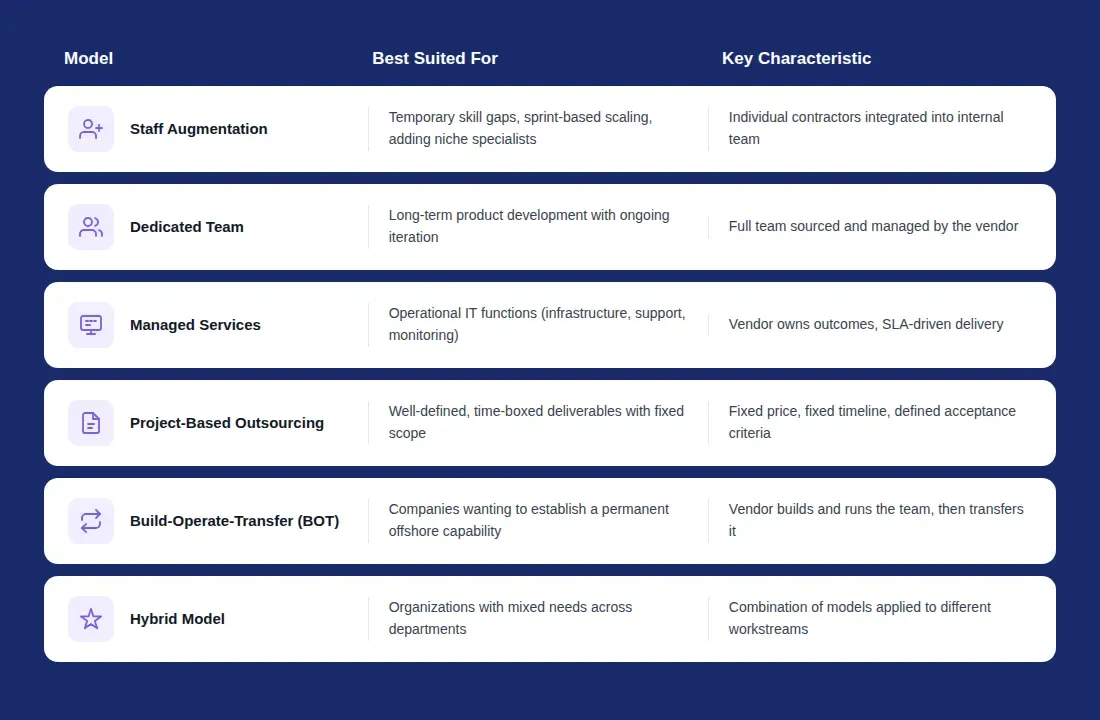
Staff augmentation. We place vetted engineers directly into your team, reporting to your leads and following your process. You keep full control of priorities and direction; we take the recruitment, bench and replacement risk off your plate. This is the right model when you have strong internal management and just need senior hands in specific technologies, fast. In our projects, a specialist role that would take an internal recruiter four to six months to fill is typically staffed in two to three weeks.
Dedicated team. We stand up a team that works exclusively on your roadmap, with a lead who owns delivery against agreed outcomes. You set the goals; we own the composition, the coordination and the continuity. This fits when you want consistent throughput in a product area without expanding your own HR and recruitment for every technology you touch. It is also the model where our seniority shows up most clearly, because the team is accountable for results, not just availability.
Nearshore (Central and Eastern Europe). We deliver from CEE, and we believe this is the strongest value position on the market right now. The cost advantage of deep-offshore locations has eroded as salaries rose in traditional hubs and buyers started counting the hidden cost of no time-zone overlap. Nearshore gives you competitive rates, a shared working day, strong technical education, and EU and GDPR data protection by default. When you total the real cost of collaboration friction rather than the headline day rate, this is usually where the numbers land.
Managed services. For platforms where we hold deep competency, we take an area of run-and-improve work under a defined SLA. You get a predictable service and a team that already knows the stack, instead of carrying that specialised knowledge as permanent headcount.
Hybrid. Most mature programmes combine several of the above. That is not indecision, it is fit: augmented specialists where you need control, a dedicated team where you need ownership, managed services where you need a guaranteed service level.
What are the real benefits, and the risk most buyers underestimate?
The upside of outsourcing is well documented and, in our experience, real: access to a global talent pool, variable cost that scales with your priorities, and faster delivery cycles when time zones are used deliberately (source - 6 IT Outsourcing Trends Impacting 2026 and Beyond - Auxis). Done well, it also sharpens focus: your internal engineers concentrate on proprietary, differentiating work while a specialist partner absorbs the rest.
The risk that gets underestimated is not on most risk registers. Security, IP and compliance are covered in every enterprise contract. Productivity opacity is not. Most organisations simply cannot see whether external hours are becoming productive work, because remote delivery is reported by self-declaration and managed by story points that measure effort, not outcomes. That blind spot, not the outsourcing model itself, is where the 20 to 30 percent leak lives.
How do our teams turn hours into value?
We do not close that gap with a monitoring product. We close it with how we build and run teams. Four things do the heavy lifting.
Serious vetting. Every engineer we place goes through technical and practical screening before they reach your team. The single biggest driver of cost-per-unit-of-work is seniority, and it is the one buyers benchmark least. Two vendors at the same day rate can differ by 35 to 50 percent in productive output per paid day. We would rather send you one engineer who does not need hand-holding than three who do.
Senior-heavy composition. We staff for the judgement the work needs, not the cheapest rate that fills the seat. Senior engineers make fewer expensive mistakes, need less supervision, and pull juniors up rather than dragging leads down. On a total-cost basis, a leaner senior team almost always beats a larger cheap one.
AI-augmented delivery. Our teams work with AI coding assistants, automated testing and AI-supported documentation as standard, with an engineer firmly in the decision loop. The point is not the tools, it is what our people do with them: a smaller team producing the output of a larger one, with humans reviewing and deciding while the volume work is accelerated. In our projects this compresses delivery timelines without trading away quality. Any vendor that cannot show how it uses these tools, and how the productivity gain is shared, will struggle to justify its rates by 2026.
Transparency by default. We build reporting on real delivery into the engagement from day one, so you are managing against outcomes, not against a monthly timesheet you have to take on trust. Introduce that discipline mid-contract and you get resistance; agree it up front and it simply becomes how the team works.
How do you get more value from any outsourcing engagement?
These practices show up consistently in the programmes that work, ours and others’, and they are worth applying whoever you partner with.
Separate rate benchmarking from value benchmarking. Comparing day rates tells you whether you are paying a market price. It says nothing about whether you are getting market value. The second question needs data on how the team actually works, not just what the contract says.
Treat vendor comparison as continuous. The best programmes do not wait for renewal to assess a partner. Ongoing visibility into delivery efficiency across technology areas gives you a factual basis for renegotiation and reallocation instead of an annual argument.
Hunt for automation inside the workflow. External teams often lose real time to disconnected knowledge bases, manual status reports, repetitive configuration and meeting overload. Naming those patterns and automating them lowers cost and, frankly, makes the work better for the people doing it.
What does a review of external IT spend typically find?
Whatever partner you use, these patterns recur when someone finally looks closely at how outsourced budgets are spent (source - IT Outsourcing Statistics 2025 - Zealousys):
- On average, 18 to 25 percent of contractor hours go to meetings, which usually surprises managers who assume meeting culture is an internal-only problem.
- Contractors juggling multiple tools lose 12 to 20 percent of their time to context switching and information retrieval, much of it automatable for modest effort.
- In multi-vendor setups, suppliers at the same day rate vary widely: the least efficient often deliver 35 to 50 percent less productive work per paid day than the most efficient.
- Organisations without structured visibility into contractor work typically find recoverable budget worth 10 to 15 percent of total external IT spend once they start looking.
We read these numbers as the argument for our model, not against outsourcing. Senior teams, run transparently, are how you stay on the right side of every one of those figures.
How do you choose your outsourcing approach?
Two comparisons come up in almost every conversation we have with IT and procurement leaders.
In-house hiring versus outsourcing. In-house gives you the most control over culture, institutional knowledge and long-term capability, and permanent staff offer continuity a rotating bench cannot. Outsourcing gives you flexibility and speed: two to three weeks to a specialist versus four to six months to a permanent hire, and better total value for project work, commodity functions and niche skills you do not need on payroll forever. Most organisations run both. The trick is putting each kind of work where it belongs and managing the outsourced side against outcomes rather than assuming visibility you do not have.
Freelancers versus structured outsourcing. Hiring a freelancer directly is the simplest way in, and it is fine for a short, contained task your team can manage. It does not scale. A single freelancer is concentration risk with no backup and no accountability if things go sideways, and there is no governance around parallel work for other clients. Once you are past three or four external contributors, a structured model with a dedicated team, a lead and contractual continuity consistently wins on management cost, delivery consistency and accountability. That is exactly the ground our dedicated-team and nearshore models are built for.
Where is IT outsourcing heading?
Four shifts are reshaping the market, and they all point the same way.
AI-augmented teams become the baseline. Vendors that do not work with AI coding assistants, automated testing and AI-driven documentation will not be able to defend their rates against those that do. Buyers should assess a partner’s stack and how it actually uses these tools. This is already how our teams work.
Outcome-based contracts replace time-and-materials. Paying for hours regardless of output is getting harder to defend as buyers see the misaligned incentive. More engagements will move to milestone, deliverable or value-share structures, and that is a shift we welcome, because it rewards exactly what senior teams are good at.
Visibility becomes a procurement standard. Just as financial controls and security audits became table stakes, transparency into how external teams actually work is becoming a default requirement, not a premium add-on.
Nearshore gains share against offshore. As collaboration cost outweighs the shrinking offshore rate advantage, CEE nearshore keeps winning on shared time zones, technical depth and EU compliance. We think anyone reviewing their outsourcing geography this year should price in collaboration friction, not just the headline rate.
Conclusion
Outsourcing will stay central to how technology organisations build and operate. Global talent, cost flexibility and fast scaling remain real advantages. But the expectation has moved from availability to accountability, and the model on the contract matters far less than the people delivering under it.
Our view is straightforward: pick the cooperation model that fits the shape of the work, then insist on the seniority, the AI-augmented way of working, and the transparency that turn paid hours into delivered value. That is what we build. If you want help choosing the right model for your roadmap and staffing it with people who deliver, that is exactly the conversation to have with us.
Choose a cooperation model matched to your roadmap → Team augmentation
FAQ
What is the difference between staff augmentation and a dedicated team? Staff augmentation places individual specialists who report directly to you, so you keep full control of priorities and process. A dedicated team, led and coordinated by us, works exclusively on your roadmap and is accountable for outcomes. Choose augmentation when your internal management is strong and you need specific senior skills fast. Choose a dedicated team when you want consistent delivery in a product area without expanding your own recruitment for every technology.
How much does outsourcing cost compared to in-house hiring? Rates depend on location and model. Nearshore CEE teams typically run around 30 percent below North American rates, all-in, with a shared time zone and EU data protection. But compare productivity, not just rates: a cheaper team with high idle time can cost more per unit of delivered work. In our experience, underperformance almost always traces back to thin seniority, unclear scope, poor knowledge transfer, or incentives tied to hours instead of outcomes, which is exactly what our model is built to avoid.
How do I measure the ROI of outsourcing spend? Proxy metrics like velocity, story points and commit counts measure effort and are easy to game. Real ROI is the ratio of paid hours to productive, outcome-linked work. Measuring it needs visibility into how the team actually spends its time and a partner willing to be managed against outcomes rather than availability. We build that transparency into the engagement from day one.
What governance should I put in place? Three layers. Strategically, run quarterly reviews against KPIs and check the model still fits the business need. Operationally, keep a weekly cadence and transparent delivery dashboards. Analytically, rely on real delivery data rather than self-reported timesheets. A good partner will bring this structure to you rather than wait to be asked.