

Role
Health and safety
Who notices first that a workstation has become dangerous? If it is only the person who gets injured, then all the preventive work rests on events that have already happened.
Intro call
Four questions we would start with
Who notices first that something is dangerous?
Almost always an employee - and almost always they do not report it, because reporting means paperwork and a conversation. What is not reported does not exist in the statistics or in the action plan.
What do you not know about the hazards until an accident happens?
There are many times more near misses than accidents, and they are the cheapest source of knowledge. Provided somebody collects them.
When is the decision made to remove a reported hazard?
If it depends on a department budget, some reports wait for months - and employees stop reporting, because they can see that nothing comes of it.
What do you put off first when time runs short?
Usually the walkarounds and the conversations on the floor - the only source of information that does not require someone to file a report first.
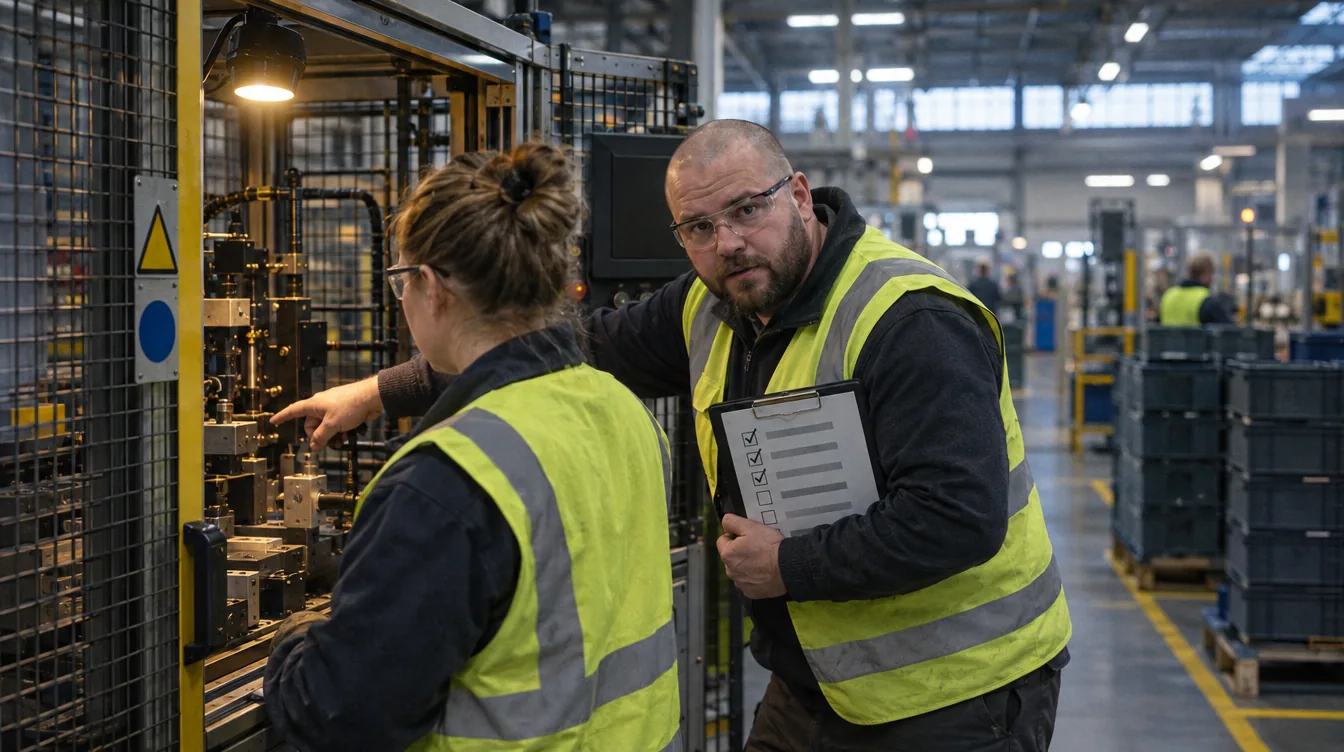
We take over the paperwork, you keep the presence on the floor
Watching training and medical check dates, risk assessment documentation, handling reports and preparing for inspections can be taken off the desk. The walkarounds, the conversations with people and judging the hazard stay with the specialist.
- Reporting has to be the simplest thing in this job. - A few taps, a photo, no two-page form. That decides whether people report near misses or not.
- Judging the hazard stays with a person. - The system orders the reports and shows what repeats. Whether that is a risk, and what kind, is settled by the specialist who knows the workstation.
- Dates are watched without exception. - Refresher training and medical checks past their date are not a matter of tidiness, they are a matter of being allowed to work.
Scope
What can be taken off health and safety
Nineteen example tasks. Each one has a human approval point. Below is a selection, and the scope we fit to your process.
Training and dates
- A register of training with validity dates for every person
- Reminders to the employee and the manager before the date
- A signal about people without valid training or a medical check
- Matching the required training to the workstation
- Documentation of workstation instruction
Risk assessment
- A register of risk assessments with a review date
- Pointing out workstations whose assessment needs updating after a change
- Linking reports and events to the risk assessment for that workstation
- Material for updating the assessment (content and judgement: the specialist)
Events and near misses
- A simple hazard report with a photo and a location
- Grouping reports by place and kind (judgement: the specialist)
- A register of corrective actions with dates and owners
- Feedback to whoever reported it on what was done about it
- Post-accident documentation in the required form (findings: the specialist)
Inspections and documentation
- A calendar of mandatory inspections and reviews
- The list of documents required for a labour inspection
- A register of personal protective equipment and replacement dates
- A summary of how post-inspection recommendations were carried out
- A periodic report on the state of safety (conclusions: the specialist)
A day's work
Today
- You watch training dates in a spreadsheet you keep yourself
- Reports come in rarely, because the form puts people off
- The risk assessment sits in a binder and is updated at the audit
- You learn about a hazard on a walkaround or after an event
- Whoever reported it does not know whether anything happened
- During an inspection you assemble documents from several places
With AI assistance
- You see people without valid training before they start work
- A report takes an employee a dozen seconds, so there are more of them
- Repeat reports from one place add up to a picture
- Whoever reported it is told what was done about it
- The risk assessment has a review date and is linked to events
- The set of documents for an inspection is ready
- Training on time
a date that has passed is visible the same day
dates are watched by a system, not in a spreadsheet
- Visible hazards
you know about near misses, not only about accidents
reporting is simple enough that people do it
- Ready for an inspection
the documentation is complete at any moment
it is built during the work, not before the inspection
- Response to an event
a report ends in an action and in feedback
actions have owners and dates
We start with the dates, because that is where the risk is greatest and the easiest to remove.
- Step 1
A register of training and medical checks
Who, what, by when. The first review usually reveals people working on documents past their date.
- Step 2
Simple hazard reporting
A few taps and a photo. We measure whether the number of reports grows - if it does not, the form is still too hard.
- Step 3
Actions and feedback
A register of actions with owners and an answer to whoever reported it. That is the condition for reports not dying out after a month.
- Step 4
Risk assessment and inspections
Linking reports to the risk assessment and the full documentation. Last, because it needs the data from the earlier steps.
Common questions
Questions that come up at the first meeting
Will a health and safety specialist still be needed?
They will, and there are no two views on it - accountability for safety is assigned to a named person and that cannot be moved onto a tool. We take over watching training and medical check dates and assembling the documentation. A specialist who is not doing that by hand is on site more often and at the binder less, and that is the whole change.
Does this fall under the AI Act?
Handling health and safety documentation is not a high-risk use. The point to watch is elsewhere: data about accidents and medical checks is health data, so access to it must be narrow and the scope of processing strictly defined.
Still have a question that is not here? Book a call

Next step
How many near misses were reported at your site last month?
We will show you what health and safety work looks like when the dates watch themselves and reporting a hazard takes an employee a dozen seconds.