

Role
Laboratory coordination
Who notices first that a sample has been waiting longer than it should? If it is the scientist at the bench, some results are produced on material at the edge of usability.
Intro call
Four questions we would start with
Who notices first that a sample has exceeded its permitted time?
If nobody does until it reaches the bench, the risk is built into the process.
When is the decision to repeat a test made?
If it is only after the result is approved, the patient or the client waits the same amount of time a second time.
How do you know the instruments are working within range?
If it is from a control once a day with no trend comparison, a drift is sometimes caught only after a run of tests.
What happens when a request arrives incomplete?
Whether the gap is flagged on receipt, or discovered when the result is released.
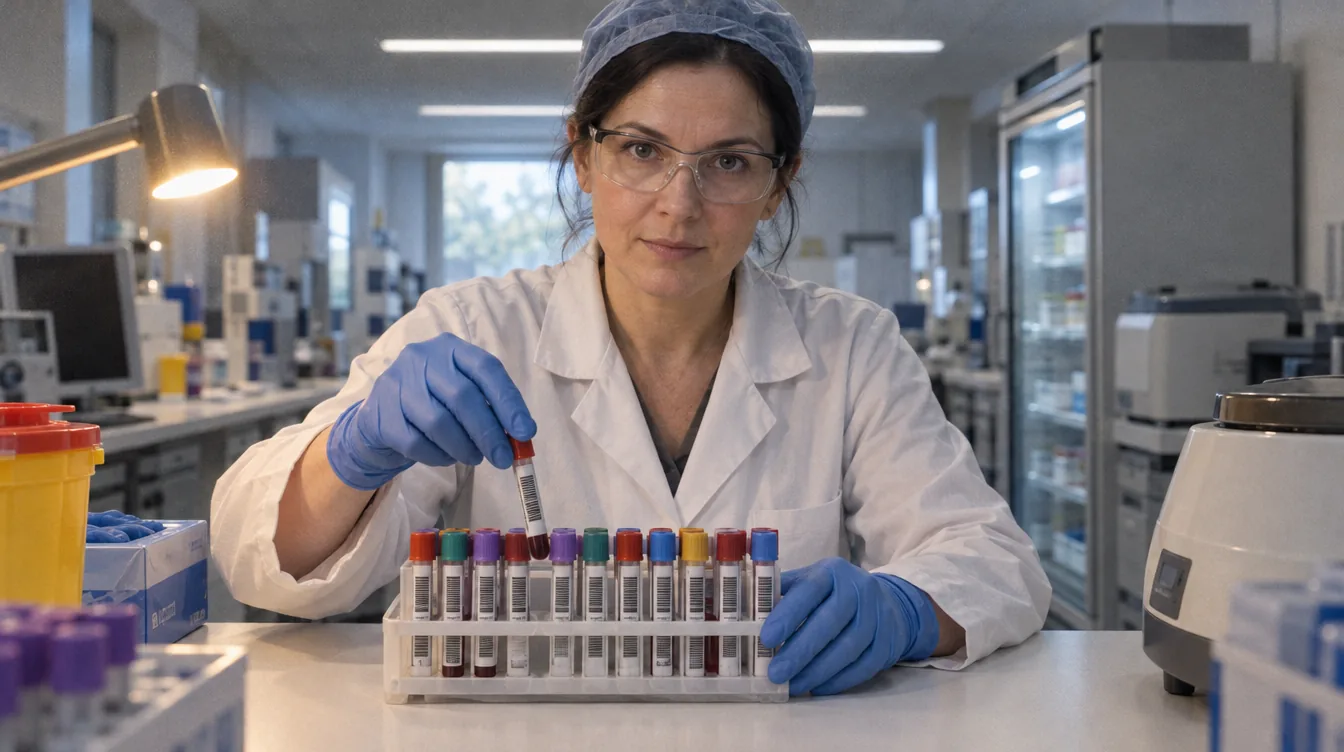
We take over the tracking and the documenting, you keep the approval of the result
Taking in requests, tracking samples, watching times and assembling documentation can be taken off the desk. Approving the result and the diagnostic judgement stay with the scientist.
- A sample has a trail from receipt to result. - Every stage with its time, so exceeding the permitted time is a signal rather than a discovery.
- An incomplete request stops at receipt. - Missing details or a missing consent are pointed out before the sample goes further.
- Quality control is compared over time. - Not only "in range or out", but also the trend that announces going out of range.
Scope
What can be taken off laboratory coordination
Twenty-one example tasks. Each one has a human approval point. Below is a selection, and the scope we fit to your test profile.
Taking in a request and a sample
- Taking in a request from one place whatever the source
- Checking the request details are complete
- Labelling the sample and linking it to the request
- A signal when a sample is received in a questionable state (assessment: the scientist)
- Confirmation of receipt to the requester
The course of the test
- Tracking the stages with the time of each
- A signal when a sample approaches its time limit
- A test queue by urgency and by the stability of the material
- Pointing out tests that need repeating (decision: the scientist)
Quality control
- Recording internal control results
- Handling participation in external quality assessment and a register of results
- Comparison against the range and against the trend
- A signal when a deviation needs a response
- Linking a run of tests to that day's control
Releasing the result
- A draft result for approval (approval: the scientist)
- A signal when a critical result needs urgent contact (decision: the scientist)
- Passing the result to the requester by the agreed route
- A register of released results
Settlements and reports
- Tests summarised by requester
- The data for settling with the payers
- Documentation for quality standards and accreditation, if you hold it
A day's work
Today
- Requests arrive in different forms and have to be completed
- You reconstruct a sample's route from records at several stages
- You learn a time was exceeded at the bench
- Quality control is judged one result at a time, with no trend
- A critical result means hunting for the requester's contact details
- You assemble the accreditation documentation before the audit
With AI assistance
- A request comes in by one route, and gaps are pointed out on receipt
- The sample's route is recorded with the times of each stage
- A sample approaching its time limit reports itself
- Quality control is also compared as a trend
- A critical result has a contact route ready
- The accreditation documentation is built as you go
- Time to result
fewer requests waiting for no reason
the queue accounts for urgency and the stability of the material
- Repeat testing
fewer repeats for organisational reasons
exceeded times are flagged earlier
- Sample tracking
it is known where a sample was and for how long
every stage records its time
- Documentation readiness
an audit does not need a week of preparation
the documentation is built during the work
We start with tracking the sample, because both time and quality depend on it.
- Step 1
The sample trail with stage times
Receipt, preparation, testing, release - with the time of each step.
- Step 2
Complete requests on receipt
Missing details and consents pointed out before the sample goes further.
- Step 3
Time signals and the test queue
Samples approaching the limit and the order set by the stability of the material.
- Step 4
Quality control and documentation
Control trends and the material for accreditation. Last, because it needs several months of data.
Common questions
Questions that come up at the first meeting
What about software that interprets results itself?
That is a separate category and a separate legal regime - software with a medical purpose falls under the medical device regulations. The scope we are talking about here concerns how the laboratory's work is organised, not the interpretation of results, and that line is deliberate.
Are fewer people enough in the laboratory?
Diagnostic activities and the approval of a result are reserved for qualified people - that is a statutory limit, not our declaration. We take over tracking the sample, watching the times and assembling the documentation. With a rising number of requests that usually means the laboratory keeps up without adding posts, not that it cuts them.
Does this fall under the AI Act?
Organising a laboratory's work is not a high-risk use. The line runs at interpreting results and supporting diagnosis - an area also governed by the medical device regulations and requiring a separate approach. That is why the scope covers the sample's route and the documentation, not the content of the result.
Still have a question that is not here? Book a call

Next step
How many of your tests were repeated last quarter for organisational reasons?
We will show you what laboratory work looks like when the sample's route is recorded and an exceeded time is a signal.