

Role
Maintenance
What do you not do, even though you know you should - because another machine has just gone down? The answer to that question describes exactly the debt that comes back as a breakdown in three months.
Intro call
Four questions we would start with
What do you not do, even though you know you should?
Services postponed, replacements put off, observations never written down. That list usually exists only in the technicians' heads.
When is the decision to stop a machine for a service made?
If it is only once production eases off, then planned services are not planned, they are occasional.
How many times a month does the same machine come back with the same fault?
If you do not know, you also do not know whether you are fixing the cause or the symptom.
What do you drop first when there are more tickets than people?
And whether that choice is made consciously, or according to who phones loudest.
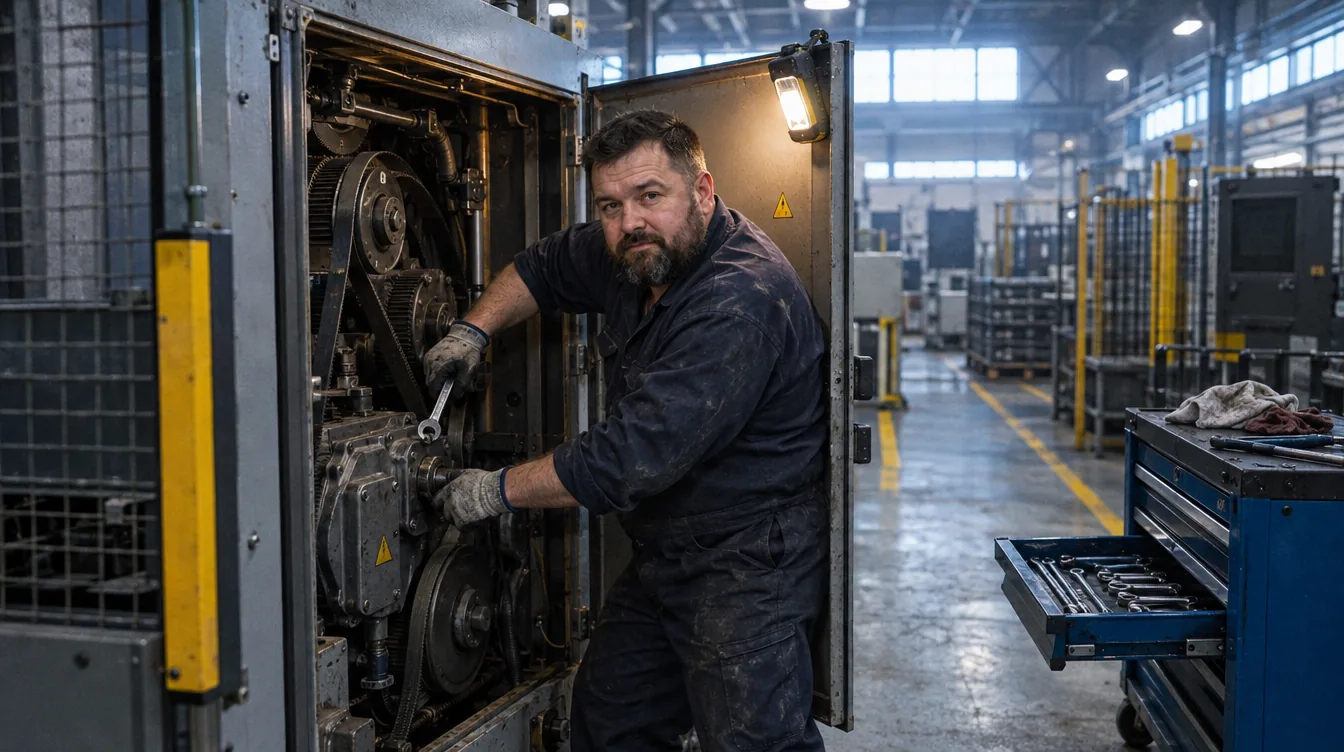
We take over the records and the chasing, you keep the diagnosis and the repair
Taking in tickets, the service schedule, keeping the machines' history and watching the parts can be taken off the desk. The diagnosis and the decision on a repair stay with the technician.
- A ticket has one route and a priority. - What counts is not who phoned loudest, but what is down and what effect it has on production.
- A planned service has its own window. - Service dates enter the production plan as time the resource is taken, not as a request to the planner.
- A machine's history is complete. - Every breakdown, repair and replacement stays with the machine, so that recurrence is visible rather than guessed.
Scope
What can be taken off maintenance
Twenty-one example tasks. Each one has a human approval point. Below is a selection, and the scope we fit to your machine park.
Breakdown tickets
- One reporting route from the floor, with the machine and the symptom
- Setting a priority by the effect on production (correction: the specialist)
- Assigning the ticket to a technician, accounting for their workload
- Feedback to whoever reported it about the status
- Recording the response time and the repair time
Planned services
- A service schedule by running hours or by calendar
- A signal when a service date is approaching
- Raising the shutdown window with production planning
- The list of service activities by type of machine
- Confirmation of completion with the technician's remarks (entry: the technician)
Spare parts
- The stock of critical parts by machine
- A signal when a part falls below its minimum
- Linking part consumption to the machine's history
- A proposed order (decision: the specialist)
The machine's history
- A machine record with the full history of events
- Downtime summarised by machine
- Pointing out faults recurring on the same machine
- The cost of maintaining a machine over the period
Cause analysis
- Tickets summarised by symptom and sub-assembly
- Pointing out the machines with the highest breakdown rate
- Comparing the breakdown rate before and after a repair (assessment: the specialist)
A day's work
Today
- Tickets arrive by phone, by radio and through the shift supervisor
- The priority is set by whoever phones last
- You postpone a service, because production never gives the machine up
- The machine's history is in a notebook and in two technicians' memories
- You order parts when they run out
- You do not know which fault comes back most often
With AI assistance
- Tickets come in by one route, with the machine and the symptom
- The priority follows from the effect on production, you correct it
- A service is a window in the production plan rather than a request
- The machine's history is complete and available to every technician
- A part below its minimum reports itself before it runs out
- Recurring faults are pointed out and measurable
- Downtime
the machine comes back into service sooner
the ticket goes straight to the right technician
- The share of planned work
fewer emergency repairs, more services in their window
services enter the plan as time the resource is taken
- Parts availability
fewer repairs held up by a missing part
the minimum stock is flagged before it runs out
- Knowledge of the machine
the history does not disappear when a technician leaves
the events are recorded with the machine
We start with the tickets, because they take the most time and are the easiest to put in order.
- Step 1
One reporting route from the floor
The machine, the symptom, the time. Without phone calls and radio as the main channel.
- Step 2
The service schedule and shutdown windows
Service dates visible to production planning.
- Step 3
The machine's history and the parts
A machine record with the full history and signals about the stock of critical parts.
- Step 4
Recurrence analysis
Pointing out faults that come back and the machines with the highest breakdown rate. Last, because it needs several months of history.
Common questions
Questions that come up at the first meeting
What if the technicians do not fill in the machine record?
That is a real risk and it is settled by the length of the entry. If closing a ticket needs a paragraph of text, nobody will write it. If it is choosing a sub-assembly, an activity and one sentence of remark, the entries happen. The project stands or falls on that detail.
Does this mean fewer technicians are needed?
Maintenance in most plants has a backlog rather than a surplus of hands - planned services get postponed because the technicians are firefighting. Taking over the records and the chasing of dates replaces nobody; it allows the work that has been put off for months to finally be done. It usually turns out the opposite of the fear: that there are not enough people.
Does this fall under the AI Act?
Maintenance is not a high-risk use. Data about technicians' response times concerns people, so we set it up to serve staffing and priority planning rather than the assessment of particular employees.
Still have a question that is not here? Book a call

Next step
Which fault came back most often in the last six months?
We will show you what maintenance looks like when a ticket has a priority and a machine's history does not leave with the technician.