

Enterprise AI assistants have moved from experimental pilots to essential infrastructure across financial services, healthcare, manufacturing, and professional services. They are not consumer chatbots. They handle sensitive data, integrate with core systems, meet compliance requirements, and scale to thousands of users. The market is real, expected to pass $200 billion by 2030, with assistants among the fastest-growing segments.
But in our experience the market number is not the interesting part. The interesting part is that most of these projects fail or stall for the same reason: the gap between a convincing demo and a system a regulated business can actually run is a matter of engineering judgment, not model selection. That judgment lives in people. This article is less a buyer’s guide and more a straight account of what our team built for UNIQA, one of Poland’s largest insurers, and the competencies behind it, because the case is the clearest evidence we can offer of what our engineers do.
What separates production from a prototype?
A few technical fundamentals decide whether an assistant holds up in a regulated setting. Our teams treat each of them as a competency to be got right, not a checkbox.
LLM plus retrieval-augmented generation (RAG). The language model handles reasoning and generation; RAG connects it to your knowledge base in real time. Internal documents, policies, and databases live in a vector store, and when a user asks something, the system retrieves the relevant content and hands it to the model as context. Answers are grounded in your data rather than the model’s pre-training, which cuts hallucinations and keeps responses current without constant retraining. In our view the quality of the RAG pipeline matters as much as the model itself: a weak retriever produces generic answers no matter how good the LLM.
Agentic, multi-step execution. The step beyond conversation is an assistant that acts: drafting, updating records, triggering approval flows, querying databases within a single exchange. This rests on disciplined tool use, and the criteria that matter are reliability, auditability of every action, and the depth of native integrations.
Security, compliance, and data residency. For regulated data this is as important as functionality. Data isolation keeps your content out of shared training and other tenants. Role-based access control limits answers to authorised users. Data residency keeps processing inside the required geography. On-premise or private-cloud deployment, audit logging, and alignment with frameworks like GDPR, SOC 2, or SR 11-7 for model risk are entry conditions in banking, insurance, and healthcare, not extras.
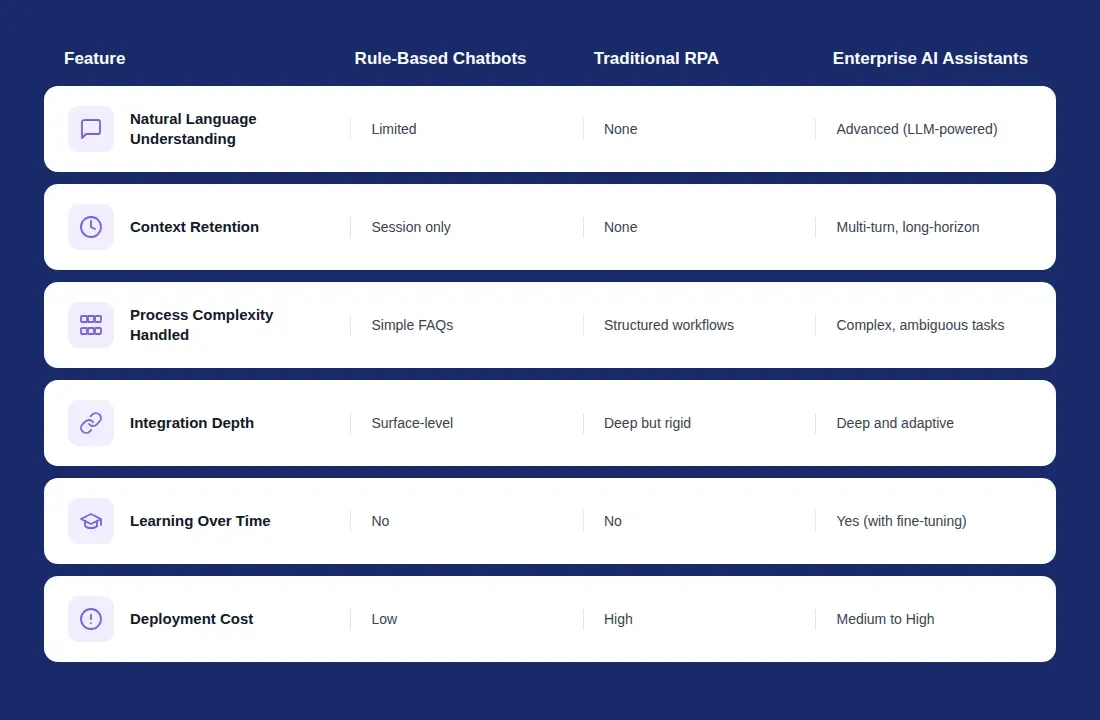
An assistant works best as a coordination layer above existing chatbots and RPA, deciding when to trigger automation, when to escalate to a person, and when to resolve a request in conversation, rather than replacing any single tool. And most deployment cost sits in integration and change management, not the platform licence, which is precisely why the team doing the work matters more than the badge on the software.
What did UNIQA need?
UNIQA faced the operational pain typical of a large, regulated insurer. Its agents and consultants worked against a vast, constantly updated library of General Insurance Conditions (OWU documents), product tariffs, and internal procedures. The sheer volume made fast, reliable access nearly impossible with conventional search, and that drove four costly problems:
- Low searchability, so agents struggled to find the right clause or provision quickly.
- High average handle time (AHT), because consultants spent real time hunting for answers manually.
- Inconsistent answers across channels, with the call centre, email team, and chatbot sometimes giving different responses to the same question.
- Slow, expensive onboarding, with no efficient way to train new agents on a complex product portfolio.
What did our team build?
Our team delivered an intelligent assistant panel embedded directly in the agent’s existing interface, built on a RAG architecture using PLLuM, a foundation model optimised for Polish. That was a deliberate call: generic multilingual models lose accuracy on Polish insurance language, and in a regulated setting that loss is unacceptable. The choice reflects the kind of decision our engineers make routinely, matching the model to the domain rather than defaulting to the biggest name.
The build addressed all four problems at once:
- An AI suggestions panel surfaces verified, ready-to-use answers during live customer interactions, removing manual document searches and pulling AHT down.
- Automated summarisation turns dense OWU legal provisions into clear, customer-facing language, cutting handling time and the risk of misinterpretation.
- Integration with the existing CRM and call-centre platforms created a single source of truth, so answers stay consistent across every channel.
For security, the solution was deployed on-premise rather than in a public cloud, meeting the requirements for sensitive policy and customer data. And the RAG architecture was configured for strict hallucination control, so every response is grounded in retrieved documentation rather than model guesswork.
What competencies were behind it?
Read the build back and you can see exactly what our team brings to a regulated AI engagement:
- Working with a Polish-language foundation model (PLLuM) where accuracy in Polish legal and insurance language is non-negotiable.
- RAG with hard hallucination control, the discipline that turns a plausible chatbot into a system regulators and risk officers will sign off on.
- On-premise delivery in a regulated sector, which removes one of the most common procurement barriers instead of arguing around it.
- Deep integration into live CRM and contact-centre systems, so the assistant acts inside existing workflows rather than beside them.
How did the team deliver it?
None of this comes from a tool; it comes from a dedicated team with the right seniority working in a disciplined, phased way. The rollout was staged deliberately to manage risk and prove results before scaling: the first two weeks on process audit and discovery, mapping workflows and finding the high-impact starting points; weeks three to six on data integration, knowledge-base preparation, and RAG infrastructure; weeks seven and eight on model calibration and a controlled pilot with selected agents; then full deployment and KPI optimisation. Start focused, validate with real users, then scale, and let adoption build incrementally instead of dropping a new system on the whole agent network at once.
In UNIQA’s own words, the assistant is “a strategic step toward modern customer service”, a tool that supports employees in real time with precise, verified knowledge, and above all a tangible improvement in insurance standards where accurate information builds customer trust.
What does it mean for regulated sectors?
For insurers, banks, healthcare providers, and other regulated organisations, the UNIQA engagement makes a specific point: domain-specific language models, strict RAG grounding, secure deployment, and deep integration deliver results generic AI tools cannot. But the deeper point is that all four are execution choices made by experienced people. The assistant is only ever as good as the team that designs its retrieval, sets its grounding thresholds, and wires it into your systems.
This is also where AI reshapes the team rather than the offer. A small, senior group of our engineers, augmented by AI tooling that handles the volume, delivers what a much larger classic team would, and faster, because the people in the loop already know which choices survive an audit.
How do you bring this team in?
If you operate in insurance, banking, healthcare, or any regulated sector and want RAG and LLM work that clears compliance the first time, the fastest path is not to assemble the capability from scratch. It is to bring in a team that has already done it. We plug in as a dedicated team that owns an assistant build end to end, or through staff augmentation when you need senior RAG and LLM engineers inside your existing team.
The UNIQA case is not a claim about a product. It is a record of what our people delivered. That is the capability on offer.
FAQ
How does an enterprise AI assistant prevent hallucinations and stay factually accurate? The primary method is retrieval-augmented generation: the system retrieves relevant documents from a verified knowledge base and uses them as the basis for its answer, rather than relying on the model’s pre-training. Effective systems add confidence thresholds, so when the retrieved content does not clearly support a response, the assistant flags uncertainty or escalates to a person. In our UNIQA build we used strict RAG controls to meet the accuracy standards insurance demands, where a wrong answer carries financial and regulatory consequences.
What does a realistic implementation timeline look like? It depends on use-case complexity, the state of your knowledge assets, and integration needs. A focused deployment for one department with a well-organised knowledge base can reach a pilot in six to eight weeks, as the UNIQA roadmap showed. Broader rollouts across multiple functions typically run three to six months from scoping to production. In our experience the single best predictor of timeline is how ready the knowledge base is, so budget time for change management and adoption alongside the technical work.
How is sensitive data and compliance handled? Through tenant isolation that keeps your data separate and out of shared training, role-based access control that mirrors your existing permissions, and audit logging of queries and responses. Where data residency is strict, on-premise or private-cloud deployment keeps processing inside the required boundaries, which is exactly the route we took for UNIQA. In regulated sectors this is reinforced with contractual coverage such as GDPR data processing agreements and SOC 2 certification.
How should we measure ROI? Use existing operational metrics, not estimated productivity gains. In contact centres, track average handle time, first-contact resolution, and queries resolved without escalation. In knowledge management, compare time-to-answer before and after and watch for fewer repeat questions to experts. Set baselines before launch, review at 30, 60, and 90 days, and monitor adoption, because an unused assistant delivers no return regardless of technical accuracy.
Bring in a team of experts, augmented by AI → Team augmentation