

Role
Dispatch and forwarding
How quickly do you find out that a load will not arrive on time - from the driver, from the client or from the carrier's system? The order in that answer decides how much time you have left to react.
Intro call
Four questions we would start with
How quickly do you find out about a delay on the road?
If it is from a client who called to ask, the response starts with an apology rather than with a solution.
What happens when a carrier turns an order down an hour before loading?
How many calls it takes and how many of them end at a rate higher than the budget allowed for.
How many people touch one transport order from intake to settlement?
Usually four, and each has a different version of what was agreed, because each spoke separately.
Where does what was agreed with a carrier go?
If it stays in a phone call, you have nothing to argue with in a dispute about a surcharge.
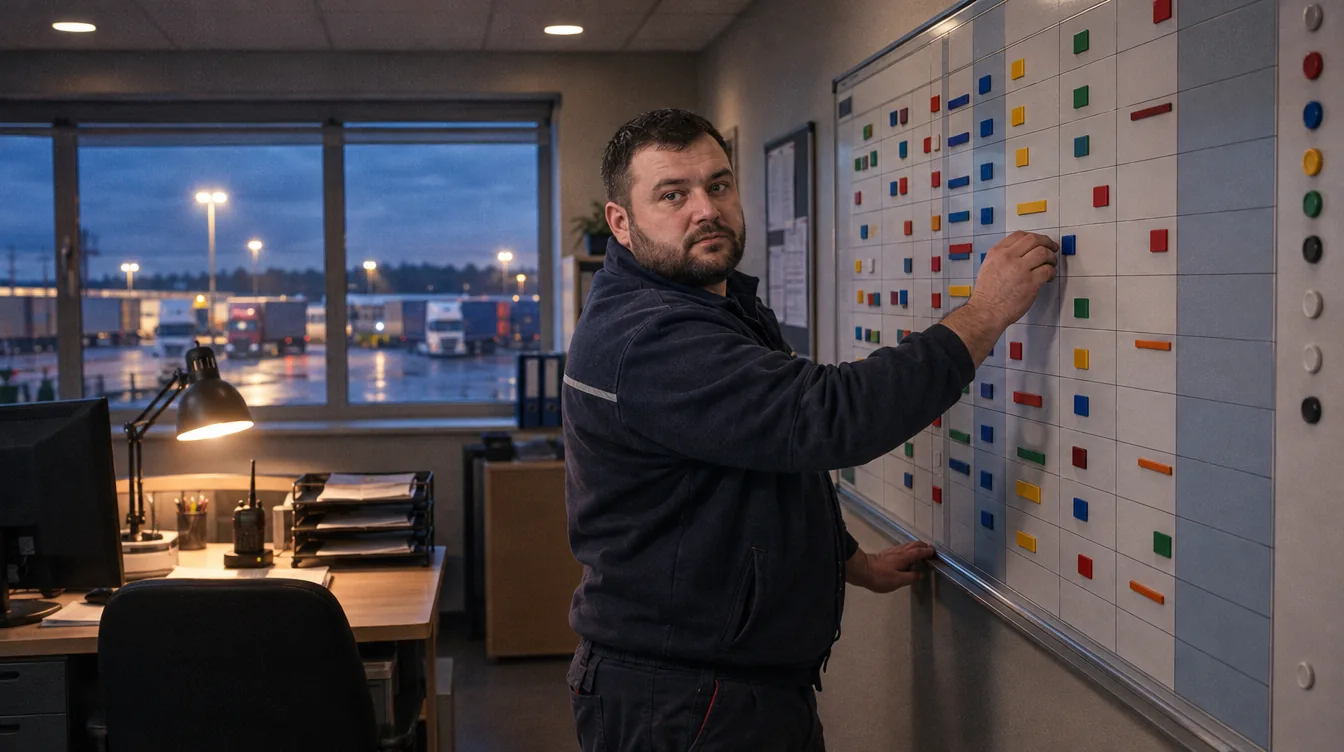
We take over handling the order, you keep the negotiation and the decision
Taking in orders, enquiries to carriers, the documents and route monitoring can be taken off the desk. Choosing the carrier and negotiating the rate stay with a person.
- An order comes in one form. - Whether it arrived by email, from the client's system or by phone - from there it goes the same way.
- The enquiry goes to several carriers at once. - The replies come back laid out side by side, and the choice stays with the forwarder.
- What was agreed is recorded. - The rate, the date, the terms - with the order rather than in the memory of a phone call.
Scope
What can be taken off a forwarder
Twenty example tasks. Each one has a human approval point. Below is a selection, and the scope we fit to your forwarding model.
Taking in an order
- One form of order whatever the channel it arrives by
- Pulling the load details, addresses and dates out of the message
- Checking the details are complete before the enquiry goes out
- A signal when an order has an unrealistic date (assessment: the forwarder)
Choosing a carrier
- An enquiry to the carriers matching the load profile
- The replies laid out with rate and date
- The history of working with a carrier on similar routes
- The choice of carrier (decision: the forwarder)
- Recording what was agreed with the order
Transport documents
- Preparing the full set of documents for an order
- Checking the requirements for the destination and the type of load
- Sending the documents to the carrier and the consignee
- Collecting proofs of delivery in one place
Monitoring on the road
- The status of an order without calling the driver
- A signal when it is running late against the planned date
- Telling the consignee about a change of date (decision: the forwarder)
- A register of events on the road
Incidents and claims
- Reporting damage with the documentation from the order
- Incidents summarised by carrier
- Material for a conversation about rates and quality (assessment: the forwarder)
A day's work
Today
- Orders arrive by email, by phone and from clients' systems, each differently
- You call carriers one after another, noting the rates on a piece of paper
- You assemble the documents by hand for every order separately
- You establish the status of a load by calling the driver
- You learn about a delay from the client
- In a dispute about a surcharge you rely on the memory of a conversation
With AI assistance
- Orders come in by one route, with the details pulled out of the message
- The enquiry goes to several carriers at once, and the replies are laid out
- The documents for an order are prepared by destination and load
- You see the status of an order without a phone call
- A delay reports itself before the client calls
- What was agreed with the carrier is recorded with the order
- Time to cover an order
a carrier is found without calling down a list
the enquiry goes out in parallel rather than in sequence
- Freight cost
fewer orders covered at the first available rate
the replies stand side by side in one view
- Deliveries on time
the response to a delay starts before the client's call
the status and the signal come from the road
- A record of what was agreed with a carrier
a dispute about a surcharge has documentary support
the terms are recorded with the order
We start with the intake of orders, because that is where most time and data are lost.
- Step 1
One form of order
Whatever the channel, with the details pulled out of the message and completeness checked.
- Step 2
Parallel enquiries and the replies laid out
The choice still with the forwarder, but made on a comparison rather than on notes.
- Step 3
Documents and confirmations
The full set of documents by destination, proofs of delivery in one place.
- Step 4
Monitoring and carrier summaries
Statuses, delay signals and material for rate conversations. Last, because it needs a history of orders.
Common questions
Questions that come up at the first meeting
What about carriers who have no system at all?
They are still handled by email and phone, but what was agreed goes onto the order on your side. We do not require carriers to integrate - we require what you agreed to have one place.
Will a forwarder be replaced by a freight exchange and an automation?
An exchange matches a load with a carrier, but it does not run the relationship and does not solve the situation where a vehicle fails to show up an hour before loading. That is the forwarder's work and it stays there. We take over retyping data and assembling documents - most of their day. The effect is that the same team covers more orders.
Does this fall under the AI Act?
Forwarding is not a high-risk use. Summaries about carriers are an assessment of counterparties rather than of individuals, and they should serve a commercial conversation rather than automatic exclusion.
Still have a question that is not here? Book a call

Next step
How many phone calls does covering one difficult order cost you?
We will show you what a forwarder's work looks like when the enquiries go out in parallel and what was agreed is recorded with the order.