

Role
Quality specialist
Who notices a deviation first - inspection or the client? Between the two usually sits the whole cost of quality and several weeks of delay.
Intro call
Four questions we would start with
Who notices a deviation first?
The operator, final inspection or the client. Each of those answers means a different cost for the same error.
How quickly do you find out that a batch departs from the specification?
If it is after the run ends, the decision concerns the whole batch rather than a few pieces.
How do you know a corrective action worked?
If the only evidence is no complaints for two months, you do not know - you are guessing.
Where do in-process inspection results go?
If they go into a report in a binder, no trend analysis can be built on them.
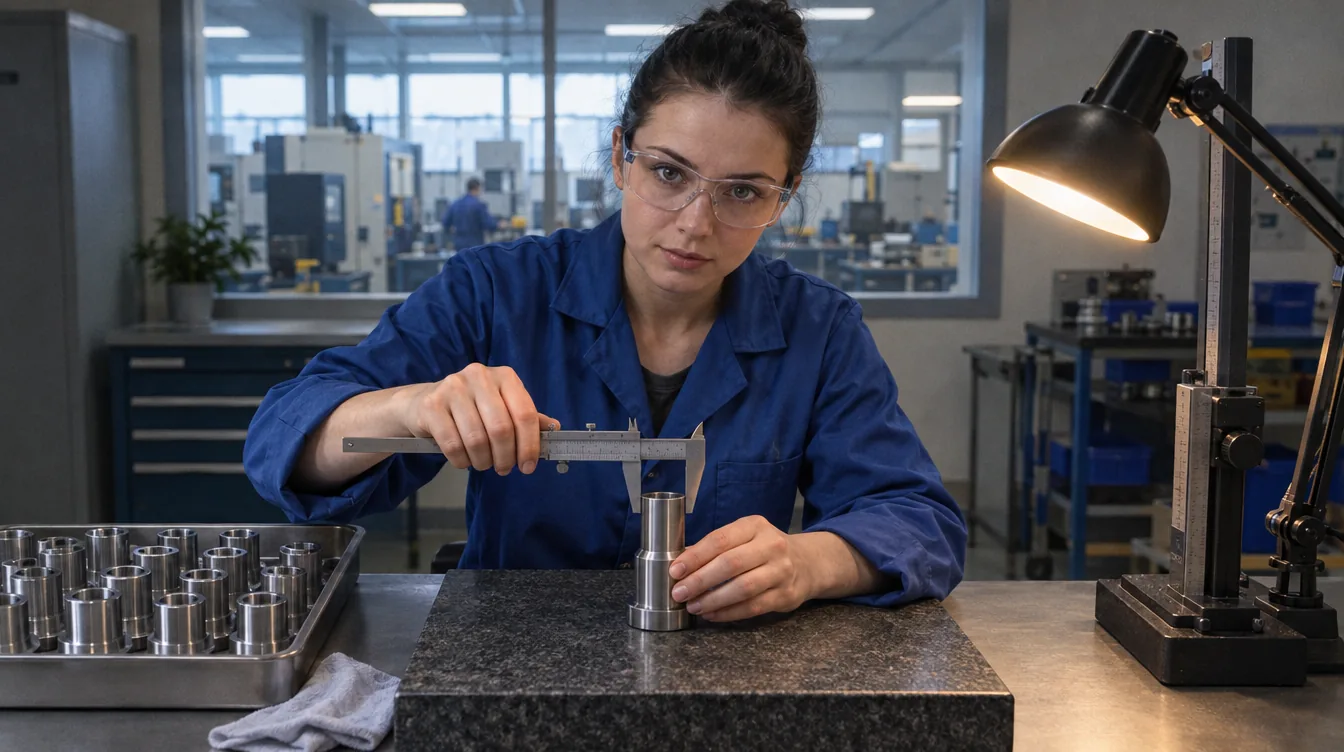
We take over the recording and the summarising, you keep the quality judgement
Recording inspection results, detecting trends, running nonconformities and assembling the documentation can be taken off the desk. Judging whether a product conforms and what to do about it stays with a person.
- A deviation should be a signal, not a conclusion from a report. - A measurement approaching the tolerance limit reports itself before the whole batch crosses it.
- A nonconformity is run as a case. - With a hold, a decision and a date, not as a note waiting for a meeting.
- The evidence is built as you go. - The documentation for an audit and for the client is assembled from recorded events, not from a reconstruction before an inspection.
Scope
What can be taken off a quality department
Twenty-one example tasks. Each one has a human approval point. Below is a selection, and the scope we fit to your quality system.
Incoming inspection
- An inspection plan by supplier and material
- Recording the inspection results at goods receipt
- A signal about a supplier with recurring deviations
- A decision to accept a batch conditionally (decision: the specialist)
In-process inspection
- A measurement schedule from the inspection plan
- Recording measurements without retyping from the instrument
- A signal when a measurement approaches the tolerance limit
- Detecting a trend across a series of measurements
- A reminder about an inspection that was skipped
Nonconformities and holds
- Opening a nonconformity record linked to the batch
- Holding the batch with notice to the warehouse and production
- Identifying the extent of the batch covered by the nonconformity
- The decision on what happens to the batch (decision: the specialist)
Corrective actions
- Running an action with a date and an owner
- A reminder when a date is approaching
- How effective the actions were after implementation
- A signal when the same nonconformity returns (assessment: the specialist)
Data for analysis
- Nonconformities summarised by product and operation
- The share of defects in production over the period
- Material for the management review
- Documentation for an external audit with no manual assembly
A day's work
Today
- You retype measurement results from the instrument into a spreadsheet
- You see a trend in a series of measurements only at the monthly analysis
- You learn about a skipped inspection while looking for the report
- You announce a batch hold by phone and email to several people
- You judge the effectiveness of corrective actions from the absence of complaints
- You assemble the documentation for an audit over the week before it
With AI assistance
- The measurement is recorded without retyping
- Approaching the tolerance limit reports itself as a signal
- A skipped inspection reminds you itself
- A batch hold reaches the warehouse and production as one event
- The effectiveness of actions is visible in a summary rather than guessed
- The documentation for an audit is ready, because it was built as you went
- Time to detect a deviation
the response concerns a few pieces rather than the whole batch
a trend is flagged before the limit is crossed
- The cost of defects
fewer products made outside the specification
the measurement and the signal happen during production
- Complete evidence
the audit and the client get the full history of a batch
the evidence is built as you go, not before an inspection
- Effective corrective actions
it is visible which actions actually worked
a nonconformity returning is detected
We start with recording measurements, because without it the signals have nothing to be built from.
- Step 1
Recording measurements without retyping
Results from instruments and workstations go into one register.
- Step 2
Trend and tolerance signals
A warning before a batch goes outside the specification.
- Step 3
Nonconformities and holds
A nonconformity record with a batch hold and notice to the warehouse and production.
- Step 4
Actions and summaries
Running corrective actions and material for the management review. Last, because it rests on recorded measurements and nonconformities.
Common questions
Questions that come up at the first meeting
What about measurements taken with instruments that have no digital output?
They are still entered by hand, but in one place and with a range check, so a retyping error is caught straight away. It also usually emerges which instruments are worth replacing first - and that is a separate, quite concrete benefit.
Will quality inspection need fewer people?
Judging whether a product conforms stays with a person - and not out of caution, but because there is no other way. We take over recording measurements, summarising and chasing the dates of corrective actions. An inspector who is not retyping results from an instrument looks at the product more often, and that is the part of the work where they actually catch something.
Does this fall under the AI Act?
Product quality inspection is not a high-risk use. The line runs at linking a nonconformity to the person who performed an operation: we record it, because it is sometimes necessary to establish a cause, but we do not build an employee assessment out of it - the summaries are kept by operation and workstation.
Still have a question that is not here? Book a call

Next step
How many of your deviations are caught by inspection and how many by the client?
We will show you what a quality department's work looks like when a measurement reports itself and the evidence for an audit is built as you go.