

Role
Records management
How long does it take you to find a document from seven years ago? If it is half a day, then during an inspection or a court dispute that time turns into a real cost - and the documents you keep, you keep for exactly those occasions.
Intro call
Four questions we would start with
How long does it take to find a specific document?
If you have to know which year and which department it came from, the archive works only for the person who ran it.
What is left when that person leaves?
Usually shelves and boxes with no description anyone from outside could understand. Knowledge of how the archive is arranged is often written down nowhere.
How do you know what can already be destroyed?
If you do not know, you keep everything - and pay for the space taken by documents you long ago stopped being obliged to keep.
Whose desk does a request for a document from the archive end up on?
Usually one person's, who has to put the current work aside. During an inspection there are dozens of such requests.
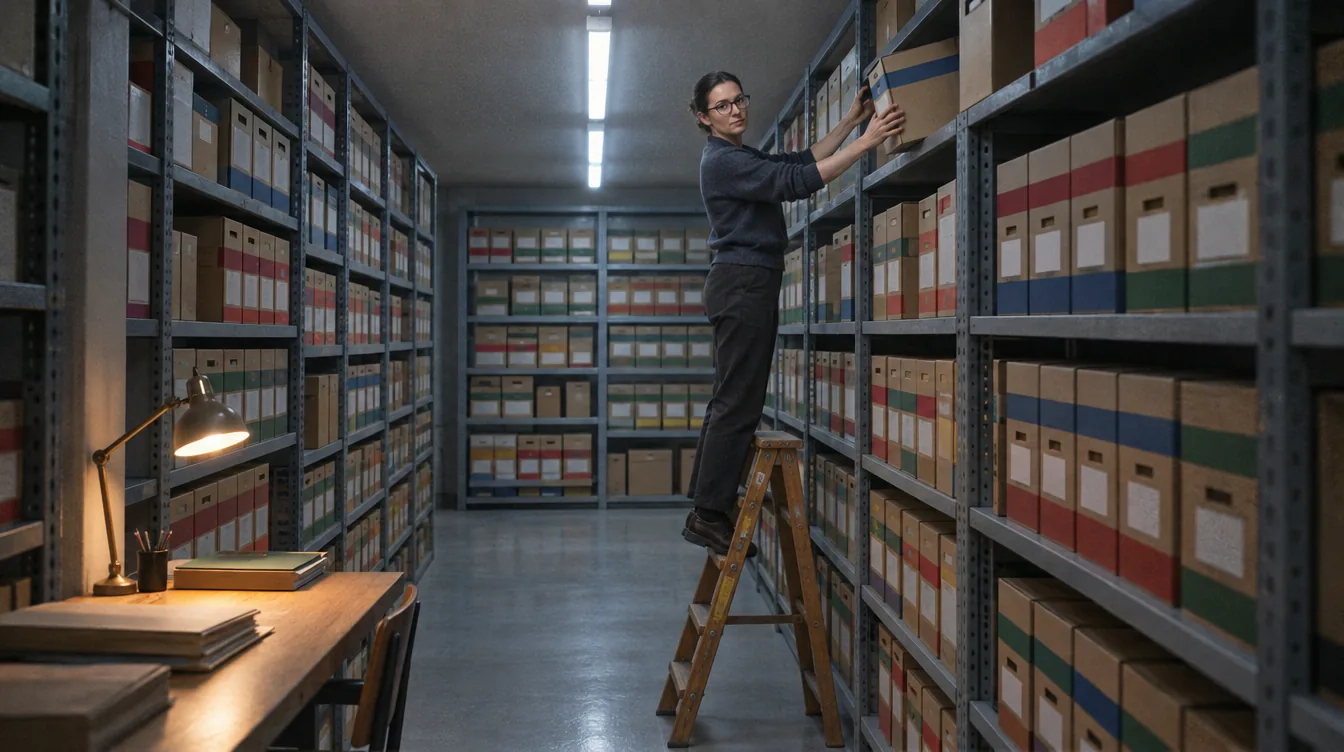
We take over the searching and the dates, you keep the decisions about the holdings
Describing documents, searching, watching retention periods and the register of disclosures can be taken off the desk. Decisions on disposal and destruction stay with a person.
- Nothing is destroyed automatically. - The end of a retention period is a signal, not an instruction. The decision to destroy a document is often irreversible and always has a name attached.
- The description is created on intake, not when searching. - That is the difference between an archive that works and a store where everything is.
- Digitisation is a choice, not a condition. - The register and the descriptions work the same way for boxes on shelves. Scanning makes sense where documents are actually taken out.
Scope
What can be taken off the archive
Eighteen example tasks. Each one has a human approval point. Below is a selection, and the scope we fit to your process.
Intake into the archive
- Taking in a batch of documents with a description of the contents
- Assigning references and locations
- Checking that the documentation handed over is complete
- A register of handovers with the date and the person handing over
Description and searching
- Describing a document under the agreed classification (verified by: the specialist)
- Searching by content, date, case and unit
- Linking documents concerning the same case
- Pointing out documents with no description or an incomplete one
Access
- A register of loans with the return date
- A register of disclosures recording who and when
- Reminders about documents on loan and not returned
- Checking the right to view (decision: the specialist)
- Preparing a set of documents for an inspection or a dispute
Retention and disposal
- A signal when a document is kept longer than its category provides for
- Retention periods assigned to document types
- A list of documents whose period has passed (decision on disposal: the committee)
- Documentation of the disposal process
- A summary of the space taken by document type
A day's work
Today
- You look for a document by remembering who handed it over and when
- When a department asks, you put the current work aside
- You do not know what can already be destroyed, so you keep everything
- Documents on loan come back, or they do not
- During an inspection you assemble documents over several days
- The arrangement of the archive makes sense only to you
With AI assistance
- You find a document by content and date, not by memory
- Requests have a queue and a status, they do not interrupt everything
- The list of documents past their retention period waits for a decision
- Loans have a register and reminders
- The set for an inspection comes from a search, not from walking the shelves
- The arrangement of the archive is described, so it can be handed over
- Time to find a document
a document is found by its description rather than by memory
the description is created on intake, not when searching
- Compliance with retention periods
you do not keep documents longer than is allowed and needed
periods are assigned to types and flagged
- The cost of space
the archive stops growing without reason
you can see what takes up space and for how long
- A record of disclosures
it is known who had sight of a document
the register is created with every release
We start with new intake, not with what is already on the shelves.
- Step 1
A description on intake
Every new batch comes in with a description and a location. The archive stops growing in a way that cannot be searched.
- Step 2
Retention periods
Assigning periods to document types. The first review usually reveals that part of the holdings could have been destroyed years ago.
- Step 3
Searching and access
A register of loans and searching by description.
- Step 4
The historical holdings
Describing what is already there, in batches, starting with the types reached for most often. Deliberately last, because it is the most expensive step.
Common questions
Questions that come up at the first meeting
Will the archive be run by fewer people?
An archive is rarely overstaffed, more often it is behind. Taking over the description on intake and the watching of retention periods replaces nobody, it allows catching up with what has sat undescribed for years. Only once the current work stops piling up can the backlog be touched at all.
Does this fall under the AI Act?
Running an archive is not a high-risk use. More relevant are the rules on retention periods and on data protection - including the principle that personal data is not kept longer than necessary. The list of documents past their period serves exactly that.
Still have a question that is not here? Book a call

Next step
How much of your archive could be destroyed today?
We will show you what archive work looks like when the description is created on intake and the retention periods watch themselves.