

Role
Line leader
What do you put off first when the line starts losing pace? Almost always the record - and almost always it is exactly that record that would make tomorrow easier.
Intro call
Four questions we would start with
What do you put off first when the line slows down?
If it is recording the cause, knowledge of the longest stoppages is lost exactly when it is most valuable.
How quickly do you find out that a component has run out on the line?
Minutes or half an hour - the difference is usually the whole of a shift's loss.
Who decides whether the line stops or runs slower?
And whether that decision is recorded anywhere, or made at the machine and gone with the shift.
How many times a shift do you stop the line for less than five minutes?
Those short stoppages are usually counted nowhere, and together they often exceed one large breakdown.
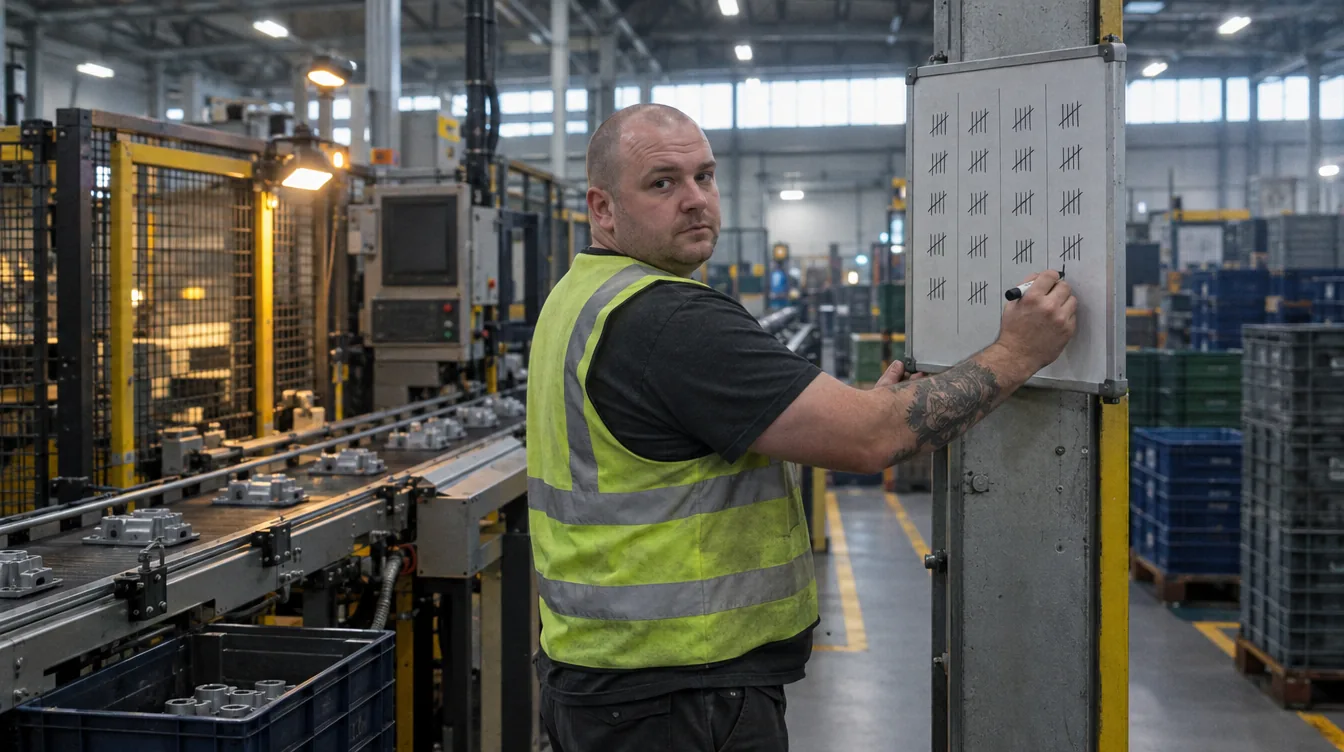
We take over the recording, you keep running the line
Recording how the shift ran, logging stoppages and defects, passing information on and collecting the crew's suggestions can be taken off the desk. The decisions at the line stay with the leader.
- Recording must not compete with the work. - Logging a stoppage takes a few seconds and happens at the line, or it will not happen at all.
- Short stoppages count too. - Stops under five minutes are recorded and added up, because they usually cost the most.
- A suggestion from the crew has somewhere to go. - An operator's remark about what slows the line enters the register and comes back with an answer, instead of ending at the machine.
Scope
What can be taken off a line leader
Twenty example tasks. Each one has a human approval point. Below is a selection, and the scope we fit to your line.
Recording the run
- The start and end time of a run - automatic where the machine gives a signal
- The number of pieces made, from the machine counter or from the leader's confirmation (confirmation: the leader)
- A signal when the pace departs from the target
- Confirmation that an order is finished (confirmation: the leader)
Stoppages and their causes
- Reporting a stoppage with one choice at the line
- A list of causes instead of a written description
- Recording stoppages shorter than five minutes
- Stoppage time summarised by cause
- Pointing out the dominant cause in the period
Defects and scrap
- Recording a defect against the operation
- A list of defect types to choose from
- A signal when a run's defect share exceeds the threshold
- Defects summarised by operation and shift
Passing information on
- Notice that a component has run out on the line
- Reporting a breakdown to maintenance
- Telling the shift supervisor that output is at risk
- Open matters passed to the next shift
Improvement suggestions
- One route for a remark from an operator
- Linking the suggestion to the position and the operation
- An answer to whoever raised it, with the decision (decision: the leader or the process engineer)
A day's work
Today
- You write a stoppage on a slip of paper, or not at all if it is short
- You describe the cause in words, everyone differently
- You call the warehouse about a missing component and wait
- You count the pieces by hand at the end of a run
- You hear operators' remarks and forget them by the next day
- Nobody knows how long the short stoppages lasted in total last week
With AI assistance
- You report a stoppage with one tap, and the time records itself
- The cause is chosen from a list, so it can be added up
- Notice of a missing component goes to the warehouse straight away
- The piece count and the run time record themselves without you
- An operator's remark enters the register and comes back with an answer
- The short stoppages are counted and their total share is visible
- Complete data from the line
events are recorded rather than remembered
the record happens at the line and takes seconds
- Time spent recording
the leader does not lose the end of the shift to reconstruction
the run is recorded during it, not after
- Visible causes of loss
it is known what takes the most of the line's time
the causes are chosen from a list and added up
- Use of the crew's suggestions
operators' remarks become changes rather than a conversation
a suggestion has a route and an answer
We start with recording at the line, because without it no summary will be true.
- Step 1
Reporting a stoppage at the machine
One choice from a list, the time stamped automatically. Everything else depends on this step.
- Step 2
Notices to the warehouse and to maintenance
A report from the line goes straight to where it triggers an action.
- Step 3
Defects and scrap
Recorded against the operation and the defect type.
- Step 4
Summaries and the crew's suggestions
Stoppage totals by cause and a route for operators' remarks. Last, because with no recorded events there is nothing to add up.
Common questions
Questions that come up at the first meeting
Will this be used to hold line leaders to account?
Our recommendation: no. The summaries of stoppages and defects concern the line and the process, not people. If the data starts serving assessment, the leader will stop recording short stoppages - which is exactly what this whole mechanism was built for.
Does this fall under the AI Act?
Recording a line's run is not a high-risk use. The only point needing care is that the data does not add up to a productivity assessment of particular operators - we set the scope at the level of the line, the operation and the shift.
Still have a question that is not here? Book a call

Next step
How long did stoppages shorter than five minutes last in total last week?
We will show you what a line leader's work looks like when recording takes seconds and the causes of loss are counted rather than remembered.