

Role
Production planner
How quickly do you find out that this week's plan has stopped being current? That one number decides whether planning is work looking forward or a constant catching up with what has already happened.
Intro call
Four questions we would start with
How quickly do you find out that material will not arrive on time?
If it is on the day it was due on the line, the plan never had a chance. If it is a week earlier, the order can be rearranged without losing a shift.
How many times a week do you rebuild the schedule?
Once is planning. Five times is reacting. The line runs somewhere in between and it is worth knowing which side you are on.
When is the decision about next week's order sequence made?
And whether at that moment you already know the availability of material, people and machines - or whether two of those three are checked after the fact.
Who notices first that the plan has drifted - you or the floor?
If it is the floor, information about a deviation reaches you only once it is a production problem rather than a planning one.
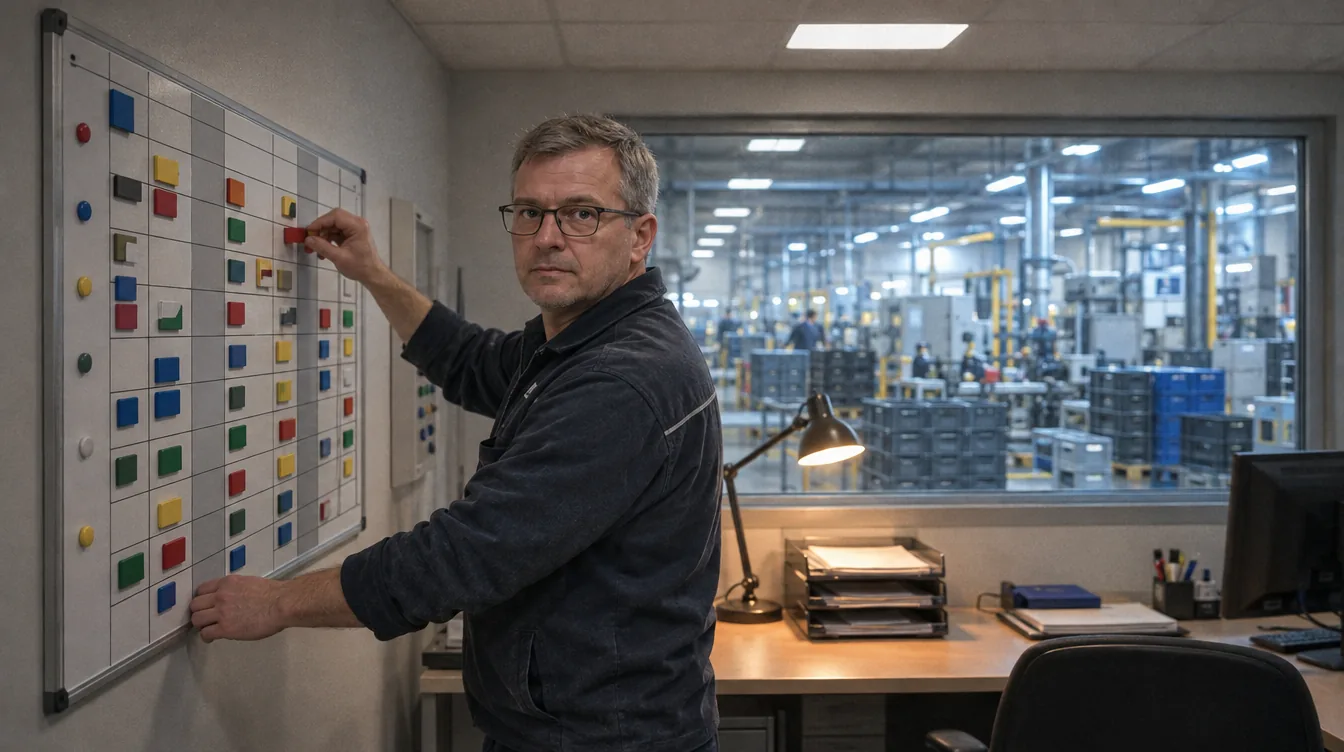
We take over assembling the plan, you keep the decision on sequence
Collecting the inputs, checking availability, flagging clashes and preparing variants can be taken off the desk. The decision about what goes first stays with the planner.
- A plan starts from complete inputs. - Material, people, machine availability and confirmed dates are checked before the schedule is built, not after it is published.
- A clash reports itself. - Two orders on the same machine in the same window is a signal to the planner, not a discovery by the shift supervisor on Monday morning.
- The variant is prepared, the choice belongs to a person. - The system shows what happens under three different sequences. Which one to take is the planner's decision.
Scope
What can be taken off production planning
Twenty-one example tasks. Each one has a human approval point. Below is a selection, and the scope we fit to your planning cycle.
Inputs to the plan
- The orders to be planned with the clients' dates
- Checking material availability for every order
- A signal when an order has no material cover
- The availability of people and the qualifications for positions
- The list of machines out of service for maintenance or a breakdown
Building the schedule
- A proposed sequence by dates and availability (decision: the planner)
- Detecting a clash of two orders on one resource
- Pointing out orders whose date cannot be met (assessment: the planner)
- Schedule variants under different priorities
- Publishing the plan in one version for every shift
Changes during the week
- A signal when delivery departs from the plan
- Calculating the effect of a delay on the following orders
- A proposed rescheduling (approval: the planner)
- Telling sales about a date at risk
- A register of plan changes with the reason
Changeovers and sequence
- Changeover times between variants
- A proposed sequence that reduces changeovers (decision: the planner)
- Pointing out orders worth combining into one run
Reviewing how the plan was delivered
- Plan against delivery by order
- The causes of deviations summarised
- Pointing out the orders rescheduled most often
A day's work
Today
- You check material availability by hand, order by order
- You learn about missing people on the day the shift is due to start
- You catch a machine clash only when somebody from the floor calls
- Every change to the plan means recalculating the whole week from scratch
- Sales ask about a date and you answer from memory
- At the end of the week you do not know why the plan failed
With AI assistance
- Orders with no material cover are flagged before the plan is built
- Missing people for a position are visible at the input to the plan
- A resource clash reports itself the moment it arises, not on the floor
- The effect of a delay on the following orders is calculated straight away
- You answer a question about a date from the current picture of the load
- You have the causes of deviations summarised rather than reconstructed from memory
- A plan that can be delivered
fewer orders planned without cover
availability is checked before, not after
- Rescheduling
the week is built once rather than five times
deviations are visible early and corrected locally
- Use of the machines
fewer empty windows and fewer changeovers
the sequence is proposed rather than rebuilt by hand
- Time to react to a change
the effect of a delay is known the same day
the recalculation happens automatically
We start with the inputs to the plan, because they decide whether it can be delivered.
- Step 1
We assemble the picture of the inputs
Material, people, machine availability in one place. It is usually visible at this stage how many orders went into the plan with no cover.
- Step 2
Clash and shortage signals
The planner is warned the moment a clash arises, not when the plan is published.
- Step 3
Schedule variants
Proposed sequences with the effect calculated. The choice stays with a person.
- Step 4
Reviewing delivery
Plan against delivery and the causes summarised. Last, because only then is there anything to compare.
Common questions
Questions that come up at the first meeting
Will a planner still be needed?
They will, because the decision about sequence rests on things that are not in the system - on the fact that this client will not forgive a delay and that one will. We take over checking availability and calculating effects, which is half a day's work. A planner who is not doing that by hand plans over a longer horizon instead of firefighting the current week.
Does this fall under the AI Act?
Production planning is not a high-risk use. The only point needing care is that staffing summaries serve capacity planning rather than assessing particular people - we set the scope so that data about people is aggregated to positions and competences.
Still have a question that is not here? Book a call

Next step
How many times last week did you rebuild the plan?
We will show you what planning looks like when the inputs are checked before the schedule and the effect of every change is calculated the same day.